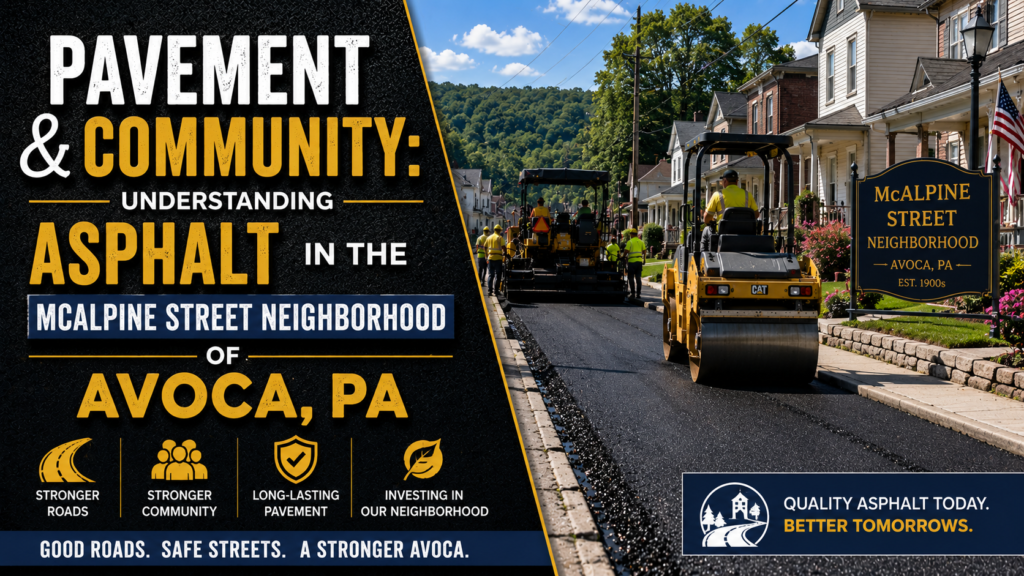
The McAlpine Street neighborhood is one of many residential corridors that make up the fabric of Avoca, a compact borough in Luzerne County, Pennsylvania, with a history stretching back to the coal mining era of the late 19th century. Like neighboring streets throughout the borough, McAlpine Street Neighborhood Avoca and its surrounding blocks reflect the story of a working-class community that built lasting homes and infrastructure infrastructure that, generations later, continues to serve its residents but increasingly shows the signs of age and weather.
In neighborhoods like this, asphalt surfaces driveways, lane ways, parking pads are among the most practical and ever-present aspects of daily life. They are also among the most commonly neglected until the point of significant deterioration. This article explores the world of asphalt paving as it relates to residential neighborhoods like McAlpine Street: how surfaces are built, why they degrade, and what can be done to extend their functional life.
A Brief Background on Asphalt in Residential Neighborhoods
Asphalt became the dominant material for residential driveways in the United States in the post-World War II era. As suburban development spread and automobile ownership became universal, the demand for paved driveways grew rapidly. Asphalt flexible, relatively affordable, and quick to install became the clear choice for most American homeowners outside of regions dominated by concrete.
In older Pennsylvania boroughs like Avoca, many driveways and private surfaces were installed in the 1950s, 1960s, and 1970s. These surfaces are now 50–70 years old, and while well-maintained asphalt can theoretically last 30 years or more, the reality in most neighborhoods is that maintenance has been inconsistent, and many surfaces are approaching or beyond their practical end of life.
The replacement and rehabilitation of residential asphalt surfaces in neighborhoods like McAlpine Street is therefore not just a convenience issue it is a fundamental infrastructure challenge that affects safety, property values, and neighborhood quality for current and future residents.
How Residential Asphalt Differs from Commercial and Road Paving
While the basic materials are the same, residential asphalt paving differs from commercial and road paving in several important ways:
Thickness Requirements: Residential driveways typically use a total asphalt thickness of 3–4 inches (divided between base and surface courses). Commercial parking lots designed for heavy trucks may require 6–8 inches or more of total pavement thickness. Roads designed for heavy loads may require even more. In residential settings, the sub-base thickness and quality are critical because the thinner asphalt section depends more heavily on the base for support.
Traffic Loads: A residential driveway primarily carries passenger vehicles, which are relatively light compared to commercial trucks. However, the passage of garbage trucks, delivery vehicles, and moving vans introduces heavier loads that residential pavement must occasionally withstand.
Edge Conditions: Unlike roads with robust shoulders or curbs, residential driveways often have poorly supported edges. Without proper edge restraints curbing, concrete borders, or compacted stone edges the sides of a driveway are vulnerable to cracking and crumbling under the weight of vehicles that park partially off the paved surface.
Aesthetic Expectations: Homeowners have direct sightlines to their driveway every day and care deeply about its appearance. Fresh, black, smooth asphalt contributes to curb appeal. Cracked, faded, and crumbling asphalt detracts from it. For this reason, residential paving work must meet both functional and aesthetic standards.
Access and Logistics: Working in tight residential spaces alongside buildings, near landscaping, under low-hanging trees, adjacent to neighbors’ properties requires care and precision that differs from open commercial or road projects.
The Importance of the Subgrade and Base in Residential Paving
Perhaps the most important lesson in residential asphalt paving is that what lies beneath the surface matters as much as the surface itself. The majority of premature pavement failures in residential settings are caused by inadequate subgrade preparation or base construction, not by poor surface materials.
Subgrade Preparation: Before any aggregate or asphalt is placed, the natural soil must be assessed and prepared. Soft or organic soils must be excavated and replaced with stable fill. Areas with high moisture content or clay soils may require geotextile fabric placement to stabilize the base and prevent migration of fine soil particles into the aggregate layer.
Base Thickness: A properly constructed residential driveway base typically uses 6–8 inches of compacted crusher run (a blend of crushed stone and fines) or bank run gravel. Skimping on base thickness a common cost-cutting measure virtually guarantees premature failure.
Compaction: Both the subgrade and the aggregate base must be compacted with appropriate equipment to achieve adequate density. Loose, uncompacted base material settles under traffic, creating the depressions and cracks that homeowners notice on the surface.
Drainage: Base material must allow water to move through and away from the pavement structure. If base material becomes saturated and cannot drain, load-bearing capacity drops dramatically. Proper grading to direct water away from the driveway perimeter is essential.
When a contractor skips or rushes these foundational steps to reduce project time or cost, the result is inevitably a pavement that fails within a few years long before its expected service life.
The Relationship Between Landscaping and Asphalt Longevity
One aspect of residential asphalt maintenance that many homeowners overlook is the interaction between their landscaping and their pavement. Trees, shrubs, and ground cover near driveways can significantly affect asphalt longevity in both positive and negative ways.
Tree Roots: Large trees near driveways are a common cause of pavement damage in older neighborhoods like McAlpine Street, where mature trees may have root systems that extend well beneath and under pavement surfaces. As roots grow, they can lift and crack asphalt from below creating raised sections, longitudinal cracks, and tripping hazards. Managing this requires either root barriers during installation or, in some cases, the difficult decision to relocate or remove trees.
Overhanging Branches: Shade from large trees can slow the drying of pavement after rain and reduce the temperature the pavement reaches on hot days. This actually has mixed effects shade can reduce UV oxidation and thermal cracking but can also keep the surface damp longer, encouraging moss, algae, and moisture-related deterioration.
Ground Cover at Edges: Plants and grass at the edges of driveways compete with asphalt for space. As they grow, they undermine edge stability and allow water to infiltrate along the edge seam. Maintaining a clean edge either with edging materials or regular trimming extends edge integrity.
Garden Irrigation: Sprinkler systems that direct water onto or near asphalt surfaces can introduce chronic moisture that shortens pavement life. Adjusting irrigation patterns to avoid driveway runoff is a simple and effective maintenance measure.
Sealcoating in Residential Settings: Timing and Benefits
Sealcoating is probably the most impactful and most accessible maintenance measure a homeowner can take to extend the life of their asphalt driveway. Yet many homeowners either don’t sealcoat at all or do it incorrectly either too soon after installation, too frequently, or with low-quality materials.
When to Apply: New asphalt should cure for at least 90 days (and ideally a full year) before the first sealcoat application. During this curing period, volatile components evaporate from the binder and the mix achieves its final density and hardness. Applying sealcoat too early can trap volatiles and interfere with curing.
How Often: Sealcoating should be reapplied every 3–5 years. More frequent application can lead to buildup of thick sealcoat layers that crack and peel. Less frequent application allows the underlying asphalt to oxidize and degrade between applications.
What to Use: Professional-grade coal tar or asphalt emulsion sealcoats provide better protection than many consumer-grade products. A professional contractor will also apply sealcoat at the correct thickness too thin provides inadequate protection; too thick creates an overly rigid layer prone to cracking.
Surface Preparation: Before sealcoating, all cracks must be filled, the surface must be thoroughly cleaned of oil stains and debris, and the weather must be appropriate dry, warm, with no rain forecast for 24–48 hours after application.
A properly applied sealcoat program, maintained consistently over a driveway’s life, can double the interval between major resurfacing events.
ADA Considerations in Residential and Small Commercial Paving
While most purely residential driveways are not subject to ADA (Americans with Disabilities Act) requirements, homeowners who are building accessible homes, and commercial or semi-commercial property owners in residential neighborhoods, should be aware of accessibility standards that apply to their paved surfaces.
Accessible pavement design includes considerations such as:
- Slope limits: Accessible surfaces must not exceed a 2% cross-slope or 5% running slope in most situations
- Surface smoothness: Paving must be smooth enough for wheelchairs and mobility aids
- Curb ramps: Where driveways or lots meet sidewalks, properly sloped curb ramps must be provided
- Detectable warning surfaces: Required at the transition between pedestrian and vehicle areas in some settings
A contractor familiar with local codes and accessibility standards can ensure that new paving meets applicable requirements from the start, avoiding costly retrofits later.
Conclusion: Investing in the McAlpine Street Neighborhood’s Future
The McAlpine Street neighborhood of Avoca represents the kind of close-knit, residential community that forms the backbone of Pennsylvania’s small boroughs. Its homes, its streets, and its people all share a history and that history is also written in the asphalt surfaces that connect properties and define the character of the neighborhood.
Maintaining and improving those surfaces is not merely a matter of aesthetics or convenience. It is an investment in safety, property value, and community pride. By understanding the fundamentals of asphalt conractor Mcalpine Street, the causes of pavement failure, and the options available for maintenance and repair, residents of McAlpine Street can make informed decisions that serve their properties and their community for generations to come.